When’s the first time you used a computer in the classroom?
For many of us born in the 2000s, it’s a question we struggle to answer. Canvas launched in 2011, and other learning management systems such as Google Classroom and Blackboard were prolific in the early 2010s as well. For us, this sort of technology has existed for most of our lives.
“It was omnipresent from the moment they gave us iPads or Chromebooks in school,” said Makaria Rufanov, a criminology and psychology student at Oregon State University. “In middle school, when we got assigned our little Chromebooks, that’s when I remember using Google Classroom.”
Many of us students only have vague memories of a time period before computers in classrooms, when assignments were papers turned in by hand, and when grades came in the form of a physical report card at the end of the semester. It was more like a fairy tale than a lived experience.
This fairy tale of what academics were like was reality for Kristy Kelly, a professor for the School of Writing, Literature and Film at OSU, when she was in school in the 2000s.
“We didn’t have learning management systems in my high school,” said Kelly. “I had a keyboarding class, but it was very low tech…we didn’t have laptops. There were no computers in the classrooms.”
Over time, schools and universities gradually integrated technology into their curriculum. The shift was not an overnight jump to Canvas. Like the evolution from MySpace to Facebook to TikTok, modern Learning Management System (LMS) platforms had several predecessors.
“I think I had Blackboard pretty much all through college,” said Kelly. “It had such a horrible reputation…what I recall it as was the place you could turn in work, but a lot of teachers still just said ‘print it out,’ and that was the norm.”
That experience resonates with many students who remember Google Classroom as little more than a digital drop box. Its usefulness often depended on how comfortable instructors were with the platform.
So, where does that leave us now? In 2023, over 35% of universities used Canvas, according to an estimate from Steve Daly, the CEO of Instructure, the company behind Canvas. If they aren’t using Canvas, universities are using other LMSs instead.
As a student, Canvas can feel like our everything. It’s made itself known as the one-stop shop for assignments, grades, lectures, and exams. But is this ubiquity a positive?
Computer science undergraduate Fern Higgins seems to think so. “I definitely would prefer [academics] with Canvas, just because the calendar is able to organize everything for you, and let you turn stuff in any time of the day.”
Rufanov echoes this sentiment. “I wouldn’t enjoy having a bajillion classes that I need to print out a bajillion papers to turn in every single day of the week. I think that is wasting paper to some extent, like environmental issues, and I also just don’t think it’s necessary.”
There are many positives to Canvas and LMSs. Above all else, they allow students to be connected to the classroom in ways that were previously impossible. However, this constant connection may have drawbacks.
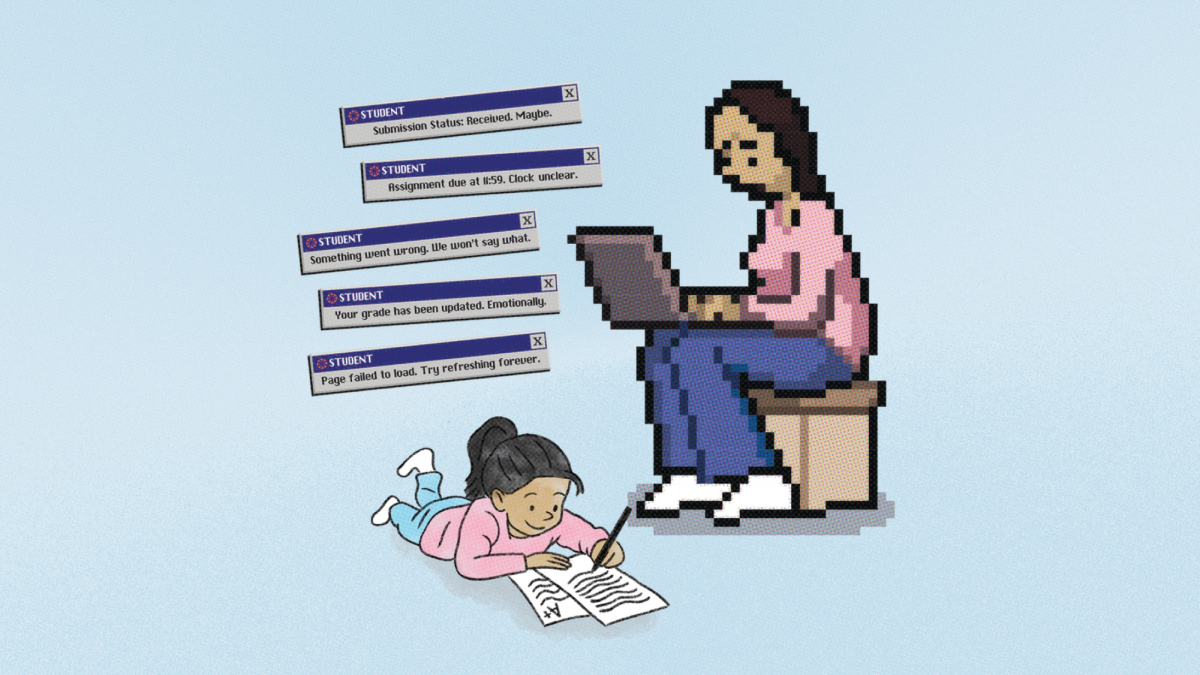
There have been growing concerns among students and faculty alike about the constant connection students have to their academics. Professors are now able to send grades and announcements directly to a student’s phones. This constant connection can be anxiety-inducing to some, who are now connected even over weekends and holidays.
“It shows you your running grade continually,” says Kelly. “It kind of makes it hard for a student to focus on anything else other than what Canvas is displaying.”
With all of these strengths and concerns of Canvas, this still doesn’t eliminate the human element of teaching. This can be viewed as a positive, that there is still that human connection between student and professor.
However, this can also be seen as a negative. Adopting new technology always comes with a slew of misunderstandings and miscommunication. We saw this, when LMSs were still in their infancy. But this problem still exists in our current Canvas era.
“Every teacher organizes their Canvas differently. That can be kind of hard to be able to find the resources I need,” Higgins said.
Higgins goes on to describe the variety she’s seen in Canvas organization. Some professors put lecture material in the Modules tab, while others put it under ‘Files.’ One professor she’s had opted to store lecture material on a separate website, while still requiring assignment submission through Canvas.
Whether you adore Canvas or yearn for the good ole’ days of paper assignments, one truth is for certain: Canvas is here to stay. With online degrees rising in popularity, LMSs have gone from a luxury to a must in the academic world. The most we can do is adapt to this ever-changing technology, and utilize it to its fullest potential.