As an Oregon State University student who has maneuvered around students clogging the bottom of the stairs in the LINC and heard the bell chimes ring through the library quad countless times, you probably think you know this place pretty well.
But, did you know that beyond campus’ tree-lined pathways, OSU is home to a nuclear reactor, bee colonies, a winery and a world of underground tunnels?
Those are only a few of the many lesser-known places on OSU’s campus.
Here’s a list of 12 places you might not know existed on OSU’s campus.
Wave Laboratory
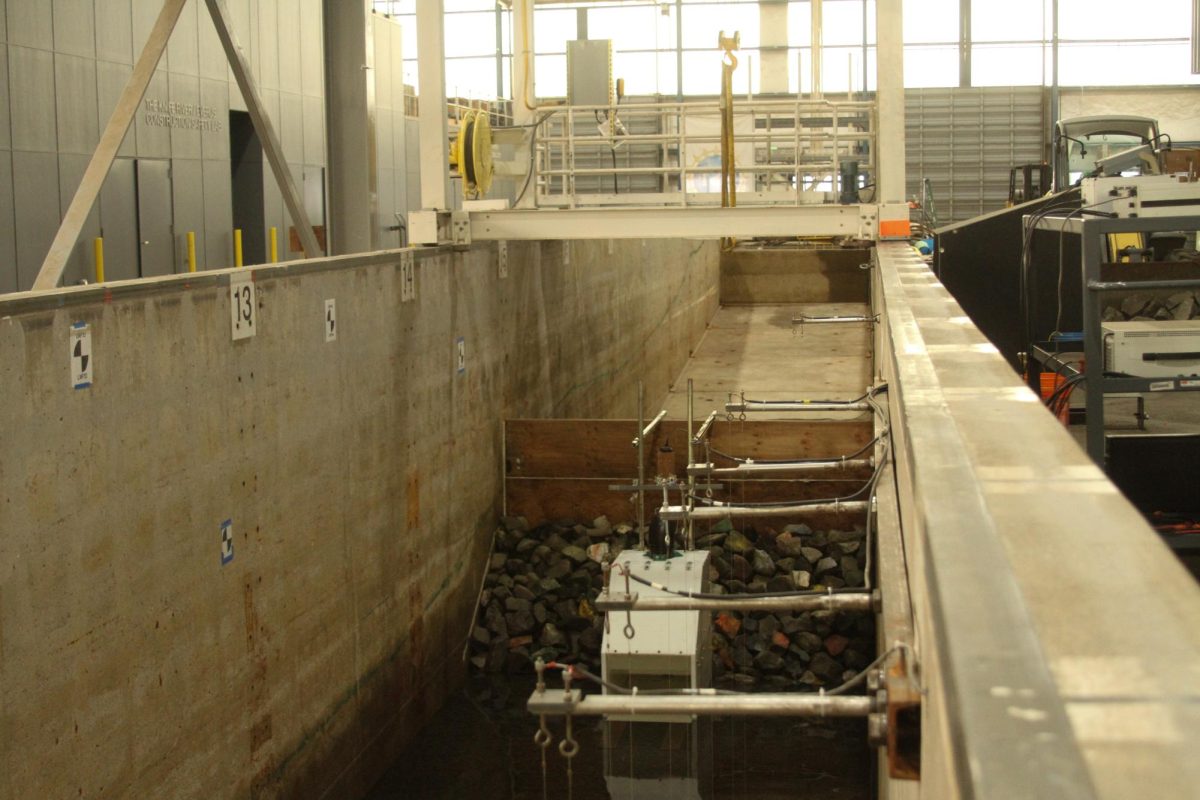
OSU makes waves with its research- literally.
The O.H. Hinsdale Wave Research Laboratory is located on campus and includes a large directional wave basin, previously known as the Tsunami Wave Basin, where modeled houses, structures, energy devices, and other structures can be hit with waves mimicking tsunamis. The coastal and ocean engineering research done at the laboratory helps with research into tsunamis and other coastal hazards.
Radiation Center
The Radiation Center is 45,000 square feet and houses the TRIGA Reactor, a research reactor. The reactor is primarily used to teach students in nuclear engineering, radiation health physics and chemistry courses how to apply what they are learning in the classroom to real-world situations.
The radiation center also includes the E2 Center, which has computer modeling that allows students, researchers, nuclear reactor operators and members of the public to gain hands-on experience being a control room operator managing nuclear reactor control systems.
Honeybee Lab
Beyond all of the busy-bee college students studying for their next midterm, OSU’s campus is home to The OSU Honeybee Lab, around 100 honeybee colonies at four different research locations in Corvallis, including on the OSU campus. The colonies are used to study issues that contribute to the decline in Honeybee colonies- including the impacts of pesticide exposure on honey bee colonies and the diseases and pathogens that affect honeybees.
The lab also provides support for academic classes related to honeybees and beekeeping at OSU and beekeeping outreach and education to the community. Oh, and also, the bee lab sells honey!
Research Brewery
Located in Wiegand Hall, the OSU research brewery can produce any style of beer and is used to develop and test new ingredients, recipes, and equipment.
The facility is available for industry use in testing new beer varieties. It also involves students in the fermentation, brewing, packaging, and pasteurization processes and provides outreach opportunities as well.
Research Winery
In the building next door to the research brewery, on Withycombe Hall, OSU has a Research Winery. At the winery, research into enology and viticulture- the science of winemaking- is done. Additionally, the winery is used for community outreach and to provide student training opportunities.
The winery was renovated three years ago, and has high-tech fermentors that are used to create and process wine, a sensory analysis facility to analyze how wine impacts senses, and a laboratory.
OSU Dairy and Other Agricultural Centers
Located just off campus on Campus Way, the 180-acre Dairy Center Complex has milking cows. Student employees and volunteers manage the cows and help collect milk. Probes and meters collect information relevant to dairy production.
OSU also uses the milk it gathers to make Beaver Classic products, such as cheese and ice cream, at the OSU Creamery and the new Tillamook Dairy Innovators Lab. Beaver Classic products can be purchased in Withycombe Hall from 11:00 p.m. to 7:00 p.m. on weekdays and 11:00 p.m. to 8:00 p.m. on weekends.
If you want to take a look at the cows for yourself, take the campus way path west from campus to see them roaming the fields. There, you might also see sheep from OSU’s sheep center munching on grass under solar panels as a part of a research study,
Clark Meat Science Center
Also known as the Meat Lab, the Clark Meat Science Center does research, processes meat, and is used to teach agriculture students at OSU and others about meat science.
The Meat Lab also has a retail store where they sell a variety of meat products, ranging from sausages to jerky and dog treats. The store is open to the public on Fridays from noon to 5:30 p.m.
Moon Tree
OSU has sent two of its alumni to space: astronauts Donald R. Pettit and Gregory C. Johnson. But another member of the OSU community has left the earth’s atmosphere as well- The Moon Tree.
The space cadet Douglas-fir is located on the east side of the Peavy Forest Science Center along SW 30th Street. The tree was grown from a seed that flew in lunar orbit during the 1971 moon landing mission, Apollo 14. The Moon Tree was planted in 1976 during a bicentennial celebration of the United States.
The Many Specimen Collections
Scorpions, soil cores deep under the sea floor and poisonous plants are some of the millions of specimens and samples collected across the world, stored at OSUs many collections located on campus. The many collections aim to store samples for research and education purposes.
Located in buildings across campus are the Herbarium, which stores plants; the Arthropod Collection; the Marine and Geology Repository (MGR); a mammal collection; and the ichthyology collection, which stores fish specimens.
Special Collections & Archives Research Center
From mementos of Oregon’s hop history to letters from the Civil War and an expansive collection spanning the Nobel Prize-winning researcher Linus Pauling’s life, OSU’s Special Collections & Archives Research Center holds hundreds of thousands of items spanning history.
The collections include an ancient cuneiform tablet from circa 3000 B.C.E., rare centuries-old books, beer taps, and Linus Pauling’s Regalia.
SCARC offers all interested individuals access to view its collections by appointment.
Ice Core Lab
In the basement of Wilkinson Hall, ice core samples taken from the depths of Antarctica can be found tucked away in the Ice Core Lab’s freezers. The samples are used to study greenhouse gases, the age of ice and glaciers, among other topics.
Ice cores stored by the lab span ages, although some are known for being noteworthy in age. This past year, a 6-million-year-old ice core was found by researchers in the lab.
Underground Tunnels
Underneath the buildings, roads and paths that outline OSU, an underground network of tunnels snakes across campus.
The tunnels span more than three miles and house steam, electrical lines and communications systems. They also transport water and some energy across campus and are often used for maintenance.