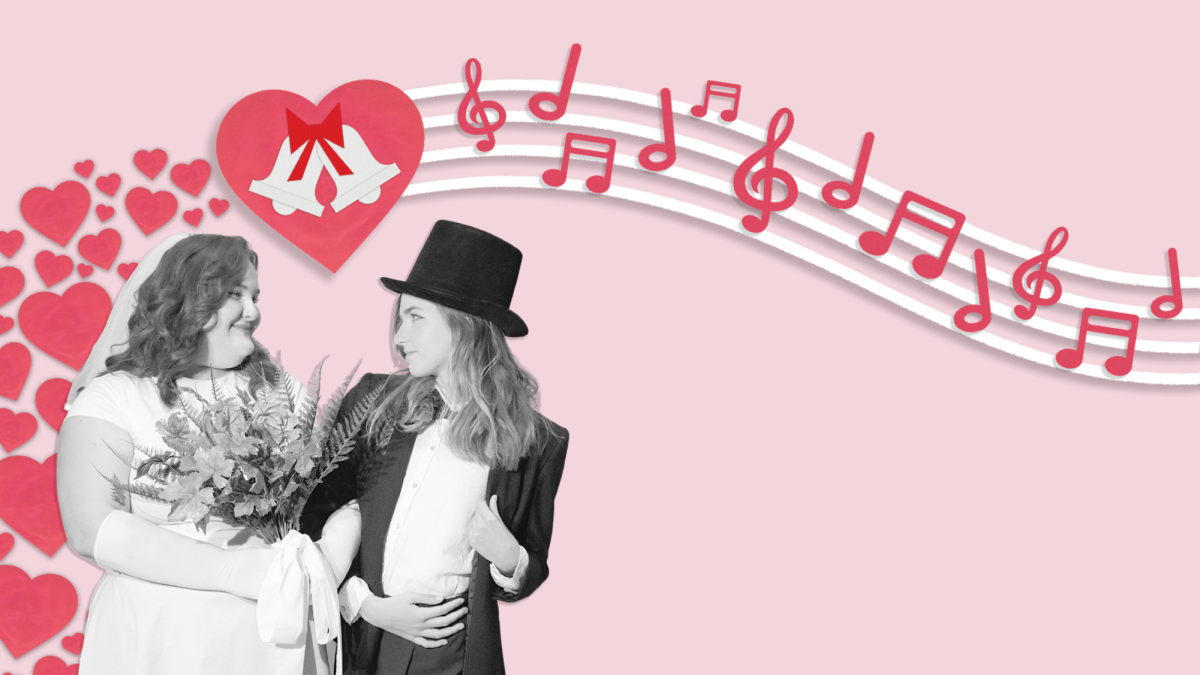
To be wed? Or to not be wed?
Aurora Benson, an Oregon State University senior majoring in Environmental Sciences and minoring in Women, Gender, and Sexuality Studies, says “you can have a fulfilling relationship without getting married, just as you can with choosing to marry.”
Catherine Bolzendahl, the director of School of Public Policy (SPP) and a sociology professor, said that when looking back at the 1950s “women had to depend on their family first, their family of origin, and then in turn depend on their husbands” in order to be secure in their lives.
For single women, it was even harder. “Women had to fight very hard” to secure themselves and their lives—whether that meant gaining equal work rights or even opening a credit card in their name, said Bolzendahl.
Susan Shaw, professor of Women, Gender, & Sexuality Studies, notes in an email that this idea of a wife that stays home and a husband that goes to work to earn money for the household, “is really limited to white women. This ideal never applied to women of color in the US.”
Shaw goes on to write, “Notice too that this ideal is based on the assumption of the heterosexual family.”
Bolzendahl echoed this, saying “The nuclear family was always only a minority of the types of families that existed.” For poor and working-class women, marriage was often a goal only after achieving economic stability.
“They feel their lives are precarious, and adding one additional person into this mix is not a source of stability,” she said.
The stereotypes of the 1950s housewife are still at large in the media today Benson says. “I believe there is also still lingering, though increasingly outdated, pressure for women to start families as soon as possible,” she says in an email when asked about the idea of people getting married right after college.
Social media influencers like Nara Smith and the Ballerina family only push these housewife ideals and pressures further, with their vlogs about their days, often featuring traditional ideals like childcare, housework, cooking, and more
“I feel like a lot of people have been gravitating towards content like this and social media in general as a reprieve from the anxieties of life … These influencers are creating a reality that is unobtainable for the average family.” Benson says.
In other words, as Bolzendahl puts it, people long for that “nostalgia” of stability when the world is changing, “our social life has changed pretty rapidly in the past couple decades.” She also recognizes that because of this many women may be reticent to marry because they may lose certain rights once they marry.
Being a young college student herself, Benson can attest to this: “The current state of the world definitely influences how I think about marriage. When the foundations of our democracy are under threat and groups of people are being attacked simply for existing in this country, I feel wary about the idea of a union certified by the government.”
Benson goes on to say, “In a perfect world, women would only get married when they truly felt it was the best decision for themselves and their partner. However, that isn’t always the reality. Many external factors weigh into that decision—religion, socioeconomic status, children, familial and societal pressures, among others. When considering people’s vast and intersecting identities, marriage becomes even more personal and unique to everyone.”
Or, as Bolzendahl puts it: “People are choosier, they’re looking for a certain level of personal and emotional fulfillment out of a partner that maybe wasn’t as important previously.”
For those who do choose to remain single, whether that be indefinitely or not, Susan Shaw believes that regardless there is a stigma around staying single. She writes in her email that, “there are plenty of penalties, both social and financial, from taxes to the additional charge for single people to travel alone on organized tours. Single people often receive fewer benefits than married people.”
The “mental load of the household” as Bolzendahl puts it, has an unbalance, “women are working full time jobs now, are successful, these duties of the households are falling on them and there is an unbalance there” between them and their partners. [18:04] Marriage is a commitment, emotionally and physically. Women are the ones who stereotypically make plans, make doctor appointments, cook the meals.
It’s not always the husband or partner’s fault however, our society isn’t set up yet to support both parents. Bolzendahl adds, “Men are more involved in childcare than ever before, but a lot of processes and policies that we have in the United States tend to minimize men’s role [in the household]” which is why women end up bearing the responsibility and strain in household duties and the relationship.
Susan Shaw chimes in to say that lesbian and gay marriages break this norm since it is “not divided by gender” whereas in many heterosexual marriages there is this divide, and often times women are assumed to only be either a “good wife/mother” or “good employee”, not both.
“Most women will get married. Most men will get married. It has always been popular. But marriage has changed its meaning in our society” says Bolzendahl.