
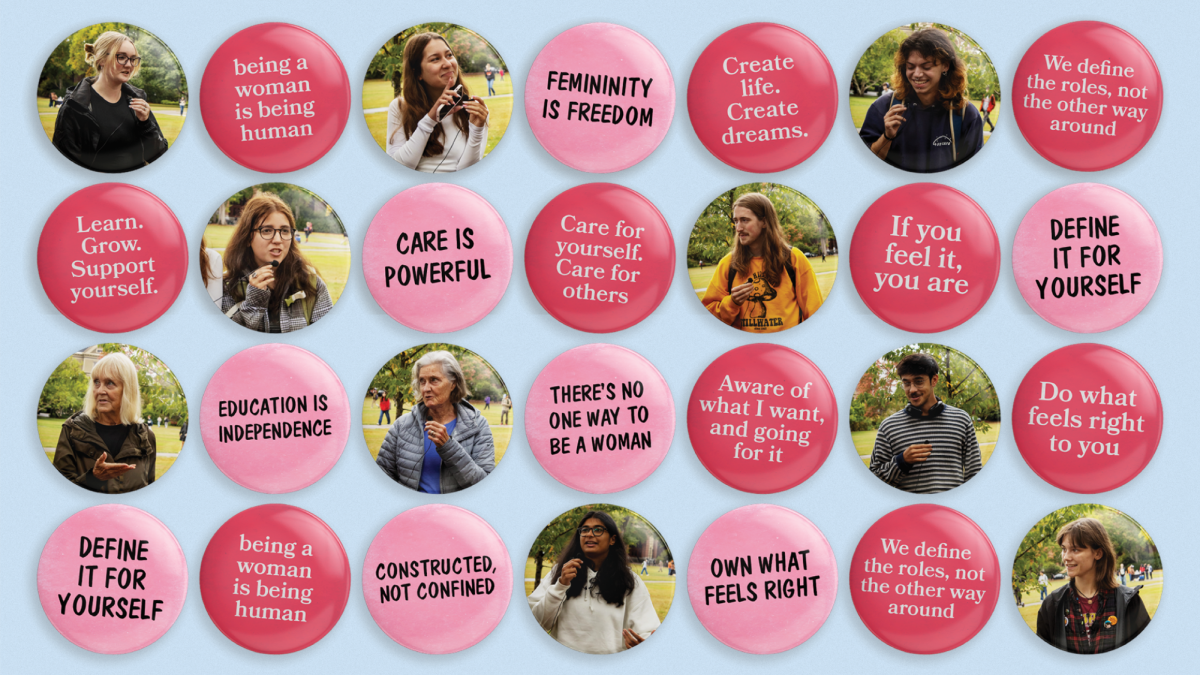
Brisk, clear, and precise, almost like the day itself, came the answers of the people from the plaza. Answers to a question that is complex and irregular. A question that explores the identity of women.
On a cool fall day, the Student Experience Center plaza was a bustle of activity. But just outside came the voices of students and faculty alike who sought to answer a question that is simple to ask, yet can be complex to answer.
“In your opinion, what does it mean to be a woman?”
Amidst a changing world, we hear lots of voices around this question. Societal values have morphed with time, creating a diverse span of thoughts. But amid the crisp, daunting call of fall, we get the privilege of hearing the voices of individuals who spoke up to give their own thoughts.
“It just means to say you are a woman; if you identify as a woman, you’re a woman,” replied Silas Dermer, a fourth year Computer Science major, when asked about the matter.
The idea that being a woman is a self-defined trait was a commonly shared thought. Amelia Bouck, a third year Fisheries and Wildlife major, added upon this.
“It means whatever you make of it. If you feel that you are a woman, and you feel that, then you are a woman, and that’s what it means to be a woman. So I think it’s kinda different for everyone.”
Leo Herboth, a fourth year Psychology major, expounded upon this idea in their own thoughts by weaving a sense of community into the matter. Leo explained that to be a woman means that you both identify as a woman, but you also have a community that supports your womanhood and shares your view of yourself in that space.
Furthermore, McKenzie Blist, a fourth year Psychology major, said, “I think to be a woman, you have to embrace your own femininity and kind of do what feels right to you.”
McKenzie went on to explain that this experience is a subjective thing. Something that can be pursued individually by each person.
“I think being a woman is not only being able to take care of yourself, but to take care of other people,” said Allie Reiss, a first year student who is currently exploring a major. Allie expounded on the fact that there is diversity in a woman’s role by saying, “It’s really an open-ended question; it can be anything you really want it to be.”
Walking with Allie was Heather McColl, a first year Nutrition major. “To me, being a woman is being very giving and taking care; you don’t have to, I just think naturally women are very giving,” Heather says.
Heather then expounded on the pressure there is in society for women to be certain things. They then spoke up about their belief that there is more to the narrative than what society might say. “You can create people and also have really cool jobs, so being a woman is you can be anything you want.”
Considering what roles a woman plays in society, Cindy Taylor, a Corvallis local, spoke about growing up in the 50s and her parents’ roles in the home. “In the era that we grew up, in the 50s, my parents were a bit unusual.” Cindy began, “My mother, she had been a teacher before they got married. They were joint decision makers.”
“My parents both, especially my mother, insisted my sister and I go to college and get an education, because you don’t know what life is going to bring, you need to be able to support yourself, so we did.”
Antara Shan, a Ph.D. student in Robotics and AI said, “For me, it’s being independent, being able to make decisions with no strings attached.” “Being a woman,” Antara continues, “you’re just understanding of what’s going on, you’re more aware of what you want to do, what you want to achieve.”
When asked about what it might mean to be a woman, Colton Auila, a Ph.D. student in Ecological Engineering said, “Gender is a construct, so it is just someone that plays the roles that we have defined as woman.”
Colton went on to explain how Filipino volleyball players may seem to have feminine traits from certain perspectives, and to some, they may seem womanly, but they are not necessarily women from their own cultural perspective.
Margie McShane, who has held a position in the Department of Education for the last six years, spoke about their generation and the way they felt that it was misportrayed in the question of their role in shaping women’s roles in society today.
“I was in college in the 70s. That’s when women were taken away, and they couldn’t run in the Boston marathon because it was a woman, and you couldn’t have a credit card in your name, because you were a woman, you couldn’t buy a house because you were a woman. All of that stuff has changed because of boomers.”
Margie showed dislike when people online talk down about their generation. “I don’t like boomers being blamed for things when they were the ones … Boomers are the ones that started all of that.”
In the essence of what it means to be a woman, Margie said, “At one time it was totally different then my impression now … My dad made all the decisions and all of that kind of stuff, and so you were put in that kind of a box. But I feel like now, being a woman is just being a human.”


