“Get curious and start experiencing things,” said Hilary Roman, an assistant director for career development for the College of Health at the Career Development Center.
“The best thing one can do to increase their chances of pursuing their dream career is to begin by engaging in the community,” Roman said.
From working full-time or part-time, to being involved in student clubs and volunteering for a local charity, even if it doesn’t pertain to your future career goals, the main thing is to follow your passions.
“There’s so many transferable skills that come from all different aspects and experiences in your life, which is really important,” said Roman.
Although the idea of success varies for every person, Roman suggests sitting down with yourself and starting by asking, “What does career success mean to me?”
It may entail climbing the proverbial ladder or just finding a comfortable career that pays the bills and allows you to provide for your family.
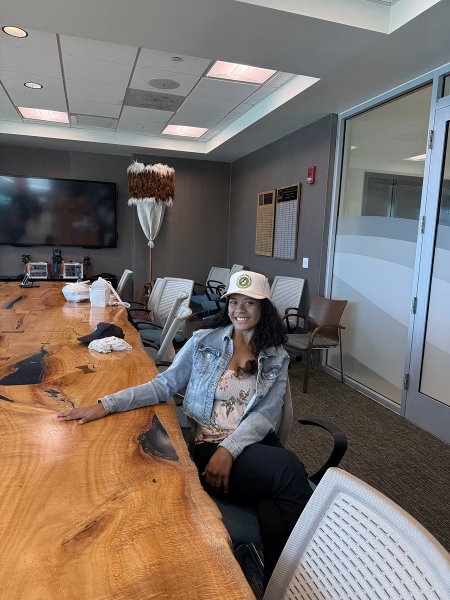
Luhui Whitebear is an assistant professor in the School of Language, Culture, and Society, a mentor for Kaku Ixt Mana Ina Haws, and coordinator of Indigenous Studies. Although she’s earned all of her degrees from Oregon State University, it was not easy.
“I was told by a mentor that people wouldn’t take me seriously in higher-ed if I didn’t have at least a master’s. So I started working on my masters in Interdisciplinary Studies while I was working full-time and parenting full-time as a single parent.”
For Whitebear, success has never been about the money gained but the goals she has accomplished and the impact she’s made through her research and mentoring students. She compares her journey to the story of the salmon, as they go on long treks but will always find their way back.
Nowadays, it is not only about what you know but also who you know. Networking may seem intimidating at first, but Roman suggests reframing it as relationship building instead of networking.
“If you don’t have a network, you could start by connecting with faculty and alumni, and even your peers. Strengthening your relationships can be very helpful in the future,” Roman says.
Whitebear, for example, attributed her success to the support of other Indigenous people on campus and emphasized the importance of having a community in college: “The degrees opened doors for me, and the relationships are what helped get the work done.”
Reem Kamil is a fourth-year senior majoring in biohealth sciences and the founder of the Arab Student Union. She aims to become an emergency room physician, a goal that came from a personal experience after a car accident.
As a first-generation student, she has felt pressure to succeed so she can set an example for her younger siblings.
For Kamil, success looks like overcoming obstacles and exceeding her expectations. Juggling a job with school while still chasing your dreams can be tough, but she says, “it is important to be honest with yourself [about] what you can and can’t handle.”
Every person is on their own journey to figure out their career; it is not a race. As long as you start, you are guaranteed to finish.