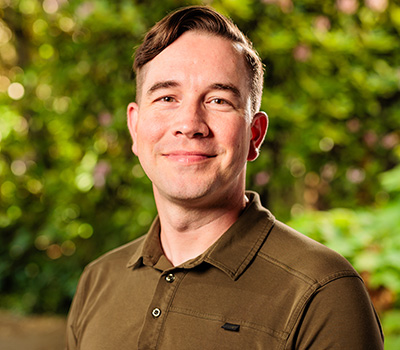
“Give geology a chance,” says Senior Instructor I, Ben Stanley, one of the professors for GEO 100 – Natural Disasters: Hollywood Versus Reality.
Stanley moved to Corvallis, Oregon with his wife in 2017 from Wisconsin, “we were in Wisconsin for a short time after graduate school at the University of Minnesota Twin Cities.”
Stanley explains that he first started off as a part time instructor where he taught multiple other bacc core classes, while also teaching at Linn-Benton Community College (he taught there exclusively during the first year of COVID). It wasn’t until the fall of 2022 that he became a full time instructor at OSU and has been teaching a full load of eight classes per academic year since then.
He goes on to list the classes, “I teach GEO 100 pretty regularly. I teach GEO 380 which is Earthquakes in the Pacific Northwest and as a bacc core course, I teach GEO 306 which is Minerals, Energy, Water, and the Environment which is a bacc core and core ed course. And I teach several major level classes for geology as well.”
GEO 100, however, is a class he, “first taught it in 2019, I inherited it from a colleague named Eric Kirby, who is no longer at OSU.”
He believes that Kirby, “at the time, he was an assistant dean, and he had developed the class with some of his colleagues as a way of getting students into geology without the normal GEO 101. ‘I’m going to talk to you about rocks! I’m going to talk to you about plate tectonics!’, that sort of thing.”
He goes on to say that when he picked up the class in 2019, he was the only professor that taught it, but now there’s an ecampus version that was originally designed by Pieter-Ewald Share. Share still teaches the Ecampus version, along with Stanley once a year, and another professor Andrea Balbas teaches GEO 100 as well.
Between the three of them, these professors will split up when they teach it, “so across the year it’s taught, I think, every term, and in the spring it’s actually taught in both modalities, both Ecampus and in person.”
Stanley talks about when he first started teaching the class that it was a 72 person class in one of rooms at the LINC, with no separate labs and mainly focused on group work. Since then, a lab section has been added and the assignments are, “short, sort of digestible and applicable to the topic of the day, and used math or math related skills to compare Hollywood versus reality.”
He says that now the class has become, “more of a standard lab class,” where there’s two lectures a week and varied lab sections at the end of the week. He sympathizes, saying he knows that, “math anxiety is a thing,” so he tries to make the labs approachable for all students, “because the first lab has more math than a lot of the rest of the labs.”
“But combined with the TAs that do a great job, and the way that they structured labs I feel like it’s quite approachable for people of all math skills and levels.”
The five topics that are covered in the class are volcanoes, earthquakes, tsunamis, hurricanes, and climate change. Stanley says, “most people look at me a little weird when I include climate change in that, because they don’t see it as a natural disaster, and it is more of a slow disaster than any of the others.”
“Even though it doesn’t feel as disastery as some of the other topics,” he says, “this is also, in my opinion, may be the only course that students will take that covers climate change in college.”
He goes on to voice that a lot of people take this class to avoid taking classes like biology or physics, which he understands, and that is why he says, “I want to utilize this opportunity to include climate change, because I think it is an important issue for voters to be informed on. And if this is the one shot that we have as a college, I want to make sure that I use it.”
“We do not end up watching an entire movie anywhere during the term, at least a full length, two hour movie, two of the labs end up being short, 50 minute documentaries, and we watch clips of movies in class.”
He jokes that, “there is no like, I’m gonna spend two hours watching San Andreas with The Rock type of class.”
“There’s a lot to learn about the natural world, and I think it’s worthwhile for everyone to know a little bit.”
He says, “I think it’s a fun way of approaching the topic. I know a lot of people enjoy geology when they get a chance to take it, so I encourage people to take this class [GEO 100] or GEO 101 [Planet Earth].”