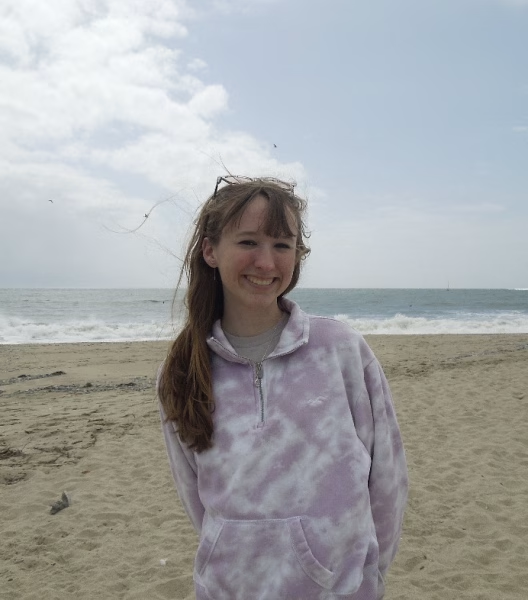
Manuel Garcia-Jaramillo, Assistant Professor for TOX 360 – The World of Poisons, believes that, “anyone who takes this class can feel more confident,” about making good decisions for a healthy life.
“I believe that we live in a very heavily focused marketing society where we are always surrounded by choices that mainly come from someone trying to sell us something,” which is why he says we need to have a better understanding of keeping a healthy balance in our lives and what information can help us decide that balance.
Garcia-Jaramillo has a background in environmental sciences, he says, “I always had a passion to try to understand how things work.”
“When I went to school, I found out that things actually were not as pretty as they look, and there were a bunch of contaminants.”
He elaborates, saying, “my PhD was focused on contaminants’ fate in agricultural soils, specifically in rice crops. So, during my PhD, I became more interested in more sophisticated analytical techniques, like the mass spectrometry, and I discovered that it was a powerful tool not to only identify contaminants, but also to understand the effects of contaminants on health.”
He worked on his PhD in Spain, at the city of Seville and then he had two externships in the Netherlands at the University of Amsterdam before he came to OSU.
Garcia-Jaramillo says that he, “was looking for positions after my PhD. When I graduated, I decided to come to OSU for an externship, and I received mentorship from a German professor in the soils and crop department, Markus Kleber.”
“During that time, I learned about the diversity of researchers at Oregon State University. I fell in love with the welcoming environment on campus.” He also talks about how he really appreciated the opportunities the university provided him, in the sense that he could do any experiments he dreamed of.
It was then he says that he, “decided to start applying for positions here, and I got a position as a post doc in the Department of Molecular Nutrition. And for a change, I went from contaminants in the environment to contaminants in human health, and that is how I started my journey into toxicology.”
“I found my passion was not only in environmental chemistry, I wanted to become a toxicologist, and I applied for a position in the Department of Toxicology,” and he started the position here at OSU in 2021.
Garcia-Jaramillo says that toxicology is, “where we combine chemistry to try and understand not only the presence and our exposure to contaminants, but also environmental and human health effects.”
Manuel Garcia-Jaramillo and Craig Marcus are the only two professors who currently teach TOX 360.
A lot of the research he has done is incorporated into the class, such as testing tap drinking water. He says that, “my idea for the TOX 360 is to give the students an opportunity to understand broader concepts of toxicology and the way that we, as a citizen, approach to the decision making of our daily lives, in terms of what products to use, healthy life habits, and so on.”
“And to make informed decisions, we need to know how things work. So we go from very fundamental basic concepts in toxicology to more complex scenarios where we have case studies,” he says.
Garcia-Jaramillo emphasizes that, “we are surrounded by environmental disasters that are happening currently, right now, and we have a voice, and we can change things,” he says that the class helps with understanding what is happening with contaminants around us and that, “we need to increase awareness.”
He says that students who take the class, “come to the class mostly without an understanding of basic concepts of toxicology, and they ended up leaving the class with not only a broader knowledge of toxicology, but also with awareness of what is happening in the environment around them.”
He says that some of the things students examine in the class is, “how are we exposed to chemicals, and what happened once that we are exposed to chemicals, how we metabolize those chemicals, why certain individuals are more sensitive to different contaminants than others? What are the different roles of exposure and main contaminant classes?”
“We dedicate a couple of lectures to environmental justice and different examples of environmental disasters that are actually happening nowadays.”
He adds that, “it’s a very active and participatory class. The students also have a writing component that they need to meet,” where he explains he limits the use of Artificial Intelligence, “we want to use new technologies in our favor, but not reduce the creativity and the input from humankind.”
When asked about what he would tell students who may be on the fence about taking this class he says, “they will enjoy learning more about how do we relate to toxicants in our daily lives,” and that taking the class will help them, “be in a better position to make informed decisions about their daily lifestyle.”
He says they will also have, “awareness about why things may have a higher or lower danger that they [companies] tell us based on facts and always to evaluate the facts and learn how to look into the published research and how to select literature to make informed decisions.”