On Tuesday night in the Thomas W. Toomey Lobby of PRAx, the School of History, Religion and Philosophy, and the School of Writing, Literature and Film co-presented The Machines Powering AI: Are Data Centers Worth the Cost?
Alicia Patterson, an assistant professor of applied philosophy and Surabhi Balachander, an assistant professor of English, facilitated a conversation with Felicity Barringer. Barringer is the Writer in Residence at Stanford University’s Bill Lane Center for the American West, and a founding editor of its magazine, & the West.
Patterson said that any of the events in this series would be perfect for any “student who may be interested in concerns about infrastructure, ecological justice, but also, their own personal relationship with AI.”
Patterson “hopes students get information and figure out what kind of action they want to take for the future.“
Patterson chose to bring in Barringer because “Felicity did a bunch of reporting specifically on data centers of the West. And I think this sort of ecological issue is at the core of people’s concerns.”
Patterson said the upcoming events in the series include presentations focusing on AI and loneliness, AI and intimate relationships and data poisoning. Patterson’s “hope for the series is to have some places on campus where we are taking these questions seriously about what we want our future to look like in regards to the use of AI.”
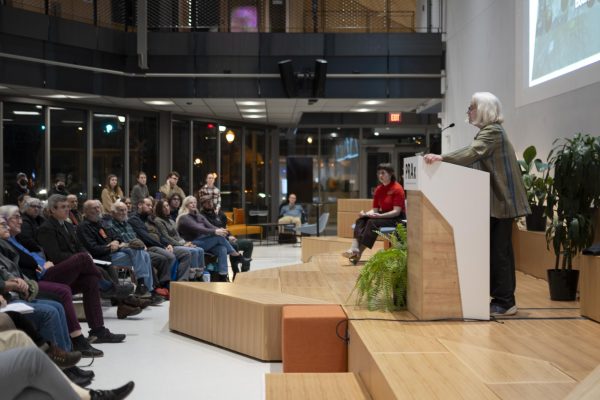
Before the event began, students, educators and community members arrived in the lobby, finding seats to listen to Barringer. Hart Sokolov was one of them, a senior fishing and wildlife sciences major. Sokolov’s interest in this topic has increased since the beginning of the new term saying “three-fourths of my classes are pushing AI required use for assignments. I think it’s important for both students and professors to understand the ethical implications of AI.”
As the presentation began, Patterson and Balachander introduced Barringer, who then presented one of her articles on AI. Barringer talked about the beginnings of social pushback against data centers, the economic concerns and the depletion of natural resources. Barringer said “as the world changes, we have to control the changes and the demand AI has on our pocketbooks and on our environment.”
After a Q&A session between Barringer and the audience members, the event wrapped up. Audience members lined up to speak further with Barringer and others mingled amongst themselves, discussing the event’s topics.
“Coming into the event, I had been aware of the dangers of AI especially for students and schoolwork,” Matt Evans, a senior philosophy major said.
“This event helped me be more aware of Oregon-specific issues regarding AI” but walked away still feeling that “students need to be more aware of how reliant they are on a chatbot,” Evans said.
“AI is here to stay, but the fact of its existence doesn’t mean it’s here to help people. You are the first generation with the task of determining the moral structure of AI, so figure it out,” Barringer said.
This event is a part of The School of History, Religion and Philosophy Ideas Matter Series: The Ethical Challenges of AI, a subsection of the PRAx annual theme for this school year. The PRAx theme is artificial intelligence and its connections to arts and humanities. Future events in this theme include Just AI: Speakers on Socially Responsible Technology, Invertigo Dance Theater: Formulae and Fairy Tales and Urland Theatre Collective: Formerly Known As.
All of the events mentioned above are presented in winter and spring term at OSU, and tickets can be purchased or reserved on the PRAx website.