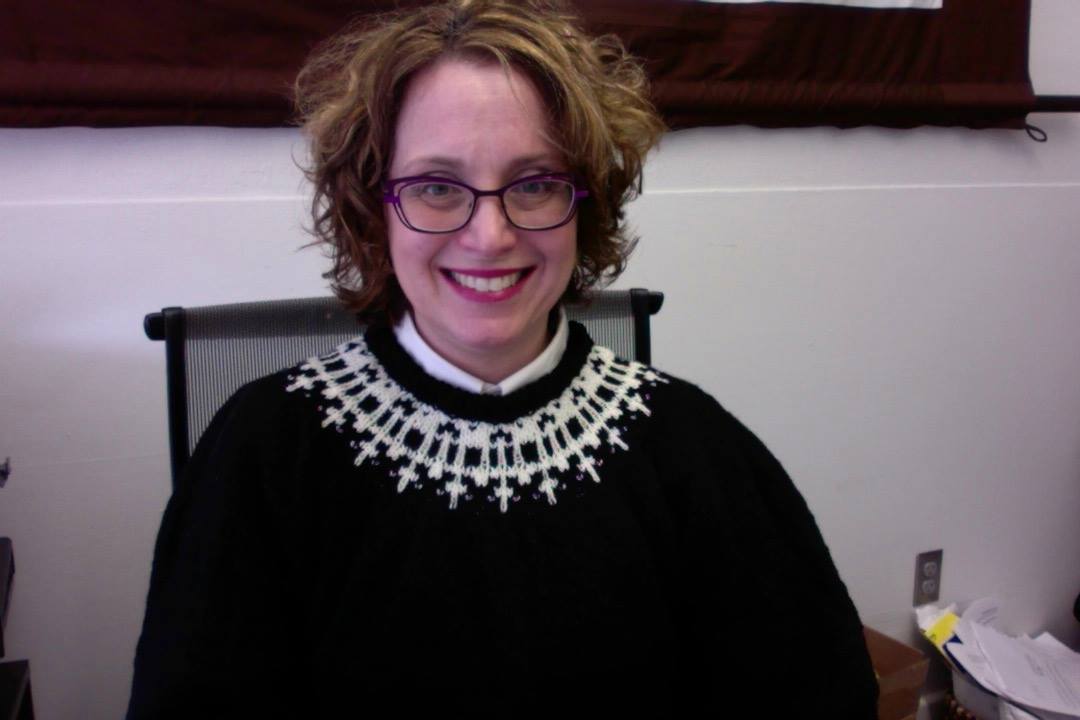
“We’re not playing The Last of Us,” says Rorie Solberg, the Professor for PS 110 – Governing After a Zombie Apocalypse.
She says the class is, “not a zombie class,” but instead about the kind of government that would be needed in a society, given the situation of a zombie apocalypse occurring and passing.
Solberg originally worked at the University of Northern Iowa but then ended up moving to Oregon in 2002. She got her degree in political science at The Ohio State University.
She talks about how the class developed while she was at a workshop for training on the difference, power, and discrimination courses.
Solberg says, “I had been seeing other colleagues that had been using, you know, the archetype of zombie or vampire or this or that for various other things.”
It was these archetypes that she saw that, “other colleagues at other universities, that study international relations, would use this kind of dystopian idea to sort of get students to think about how would we approach international relations, or diplomacy, under that kind of situation.”
“I just started, you know, drafting the scenario and the idea, and brought it to the person who was leading the workshop, who was then the head of the difference power discrimination program, and she was very supportive. And so we just moved forward with that, and that’s kind of how it came about,” Solberg says.
“There was just kind of an intersection of a lot of different things that provided it again, at the 100 level so incoming freshmen could take it. It was at three credits instead of four credits. So it provided an opportunity for students that were having trouble, you know, balancing all the demands of their majors and the baccalaureate core,” Solberg says.
Solberg is the person who developed the course and is the main teacher, but mentions that there are some graduate students who offer it online, after they’ve helped as a teaching assistant on campus.
“At its basis, what kind of government now, you know, would you set up now if our government had fallen and failed, right? Which it does in this, again, dystopian scenario,” Solberg says.
“It’s not a course on zombies, and it’s not a literature course looking at the dystopian literature. The zombie apocalypse has occurred, and we are 50 years past, and we are trying to then create a new government, given that this has all happened … it is a political science course, and it’s really a course about government.”
Solberg talks about how teaching this course during the pandemic was, “a little touchy,” she elaborates on this saying how, “it hit a little too close to home, in the sense of, oh, we could see, you know, how this kind of thing would, you know, if the pandemic went differently than it did? How, you know, all structures, all institutions would just fail, like, if you know, it would be hard to maintain what we have if we lose a huge portion of the population.”
In terms of the class structure, Solberg says that the class consists of quizzes to ensure you are doing the readings, but, “the main assignments are their constitutional proposals, which is done in group work.”
“The students first come up with a Bill of Rights, and they also have to have reasons for inclusion of each of their rights. And think about also whether the inclusion of that right creates any kinds of differences in power or in treatment or might lead to that.”
She says, “we’re always sort of thinking about the fact that you can’t make rules without creating winners and losers in some senses. And we can’t make rules without allocating resources, right?”
She talks about an example of something discussed and examined in the class: allocating who would get what house, since in this hypothetical scenario, there would be a bunch of homes left empty, “who gets the really nice house versus who gets the okay house, right? Or, if we’re in a high rise situation, who gets a nice view, who gets more bedrooms, right?”
Solberg says, “the other large assignment is writing the rest of the government is writing the rest of the government, creating your own executive branch, your legislative branch, and your judicial branch, determining your voting system.”
She goes on to say, “it’s really hard to write a constitution, and it can be really eye opening to sort of have to rethink about these government structures and to learn about what other systems exist beyond ours.”
“It can be eye opening in terms of just like, oh, there are other ways to do this, and how we would do it now, versus how we did it in 1789, it’s interesting to sort of play with.”