While Oregon State University students pass by hundreds of diverse species of plants and trees in a single day while walking to and from class, they may not all realize that the OSU campus is an accredited arboretum, full of an estimated 65,000 individual woody plants that come from all around the world.
The global diversity of the campus’ natural landscape, along with the informational signage placed on distinct plant and tree species, makes the campus a unique place to learn about plant life, and for students to see pieces of home in the surrounding greenery no matter where they are from.
This is something that Dan Blanchard, the curator of living plant collections for the campus arboretum, has worked hard to achieve.
“Many public gardens that are at colleges or universities are either off campus or designated to a certain area of campus, while ours spans the entire campus,” Blanchard said concerning the uniqueness of the arboretum.
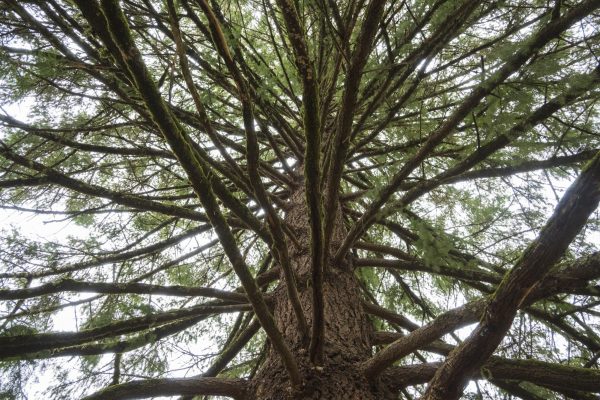
Along with teaching horticulture in the College of Agricultural Science, Blanchard has played a leading role in making the arboretum what it is today. As a graduate student, he helped to establish the status of campus as an officially accredited arboretum and he began a digital map of campus plant life that now connects to informational signage that can be found on tree trunks or on posts in the ground near plants.
Now, as the arboretum curator, he works to choose which plants and trees to introduce to campus and leads the arboretum team of 14 people in plant acquisition, physical planting, and long-term care. He also guides popular arboretum tours during welcome week, parent’s weekend, and at other points throughout the year.
“I like to say the arboretum is a place for all of us to learn, and we interact with it on a daily basis. Whether we realize it or not, we’re walking through it, we’re enjoying the beauty of it, whether or not we know what things are. And so I like to think that it’s kind of our home away from home, and it creates community.”
Blanchard took us on one of these expansive tours during our interview, in which we got to learn about the origins, species facts, and campus history of some of the 5,000-6,000 different individual trees and tens of thousands of shrubs and bushes that students walk by every day.
He said that Corvallis’ modified Mediterranean climate allows for plants to be grown here from places like South America, Chile, parts of Argentina, Brazil, South Africa, Australia, New Zealand, the Mediterranean basin, and the American East Coast to name a few.
“I’ve been really focused on trying to add plants from around the world, so that for our international students, when they’re here, maybe there’s something here that they’d see and be like, ‘Oh, I haven’t seen that since I was back home!’ and, you know, feel more connected,” Blanchard said.
Blanchard said that his favorite part of his job is sharing knowledge and giving people opportunities to appreciate food and nature. He shared his belief that food and nature are the two things that connect us all as humans, no matter how divided we may be by things like religion or language.
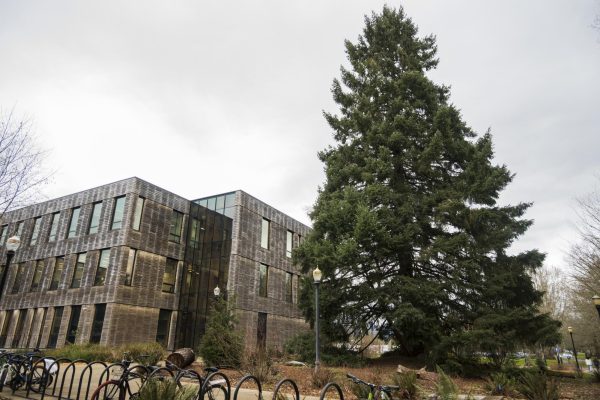
Throughout our tour, Blanchard pointed out a plethora of tree species that had been on campus for decades. He shared with us how old the trees were, who planted them, how long they’d been on campus, if they had ever been relocated, and the unique story of each one that he had uncovered through his own archival research.
“I love giving tours, because I’m getting to share that knowledge. And I love history, so all my tours have history about our campus and some of the buildings and who planted things. To me, you know, when we think about what connects people with stories, the best speakers are great storytellers, because people can imagine themselves in that story.”
Blanchard pointed out three specific trees that tell historical stories on the arboretum grounds.
One of these trees is the Apollo 14 Moon Tree. According to the plaque made by Oregon State University in front of this Douglas Fir, the seed for this tree flew in lunar orbit in 1971. It was part of an experiment to see if space would affect the germination of seeds.
Other seeds were distributed to other important international people, including the White House and the Emperor of Japan. The tree was planted in 1976 and rededicated in 2011 to honour astronaut Stuart Roosa.
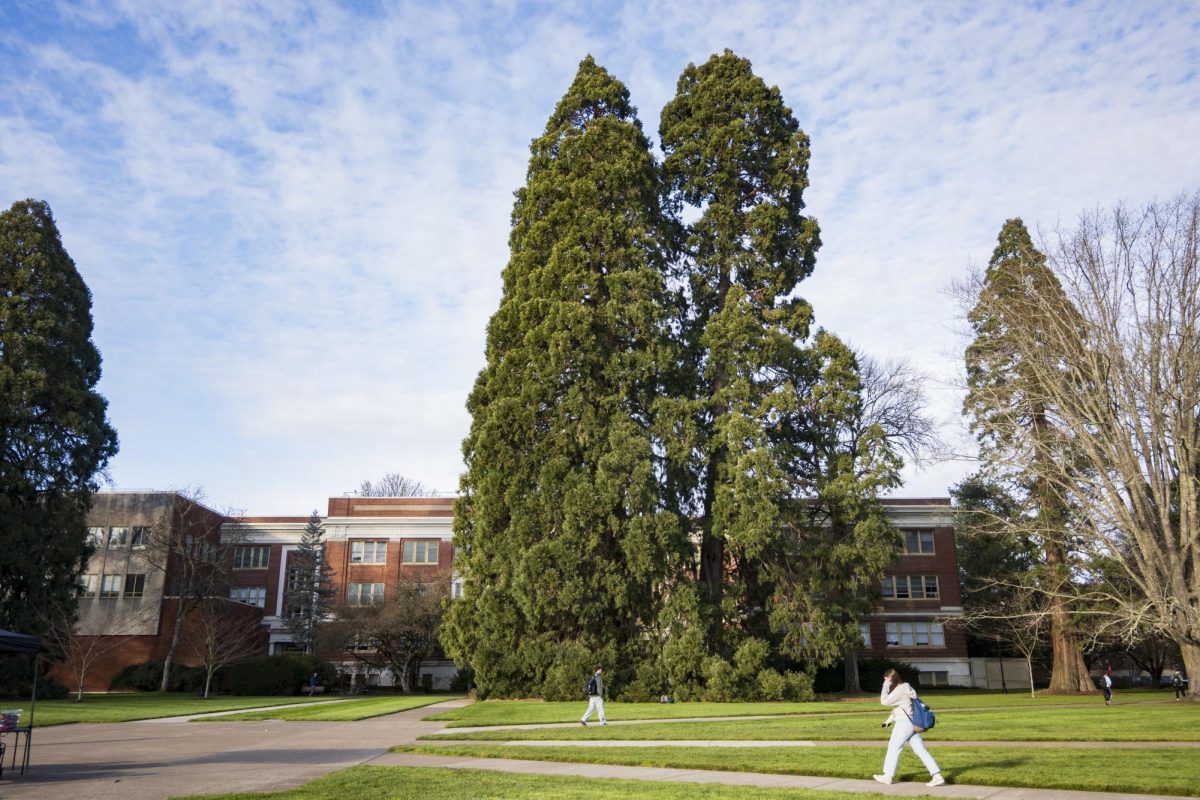
There is also a group of three Sequoias in the MU quad that shares important historical stories for the campus. According to the Progress Magazine by Oregon State University, these trees will be celebrating their centennial birthday in 2027.
According to an article by the Patricia Valian Reser Center for the Creative Arts (PRAx) at Oregon State University, these trees had the large art installation “Emeritus” hung in them from October 2022 to December 2023. This sculpture was made by the artist John Grade and was meant to represent a ghostly missing tree in the middle of the tree trio.
Another historical tree with a story found on campus is the Hiroshima Peace Tree. This tree can be found outside of the Asian & Pacific Cultural Center on campus and is often seen with multi-colored ribbons tied around its branches.
According to an article from the College of Liberal Arts at Oregon State University The Hiroshima Peace Tree was planted from seeds of a tree that survived the United States’ bombing of Hiroshima in 1945.
This tree sits as a memorial to two Hiroshima survivors, Dr. Hideko Tamura Snider and June Ikuko Terasaka Moore, sharing a legacy of peace and life rather than one of destruction.
Paired SOTS:
To see an interactive map showing where these people’s favorite trees are, see the link below.
BD Our Home Away From Home: Tree Map
On a sunny, brisk, mid-winter day, students weighed in about some of their favorite trees on campus and their experiences interacting with the arboretum.

with his friends. (Liam Flannery)
Monty Franklin, first-year Spanish and pre-nursing major
Monty Franklin, a first-year Spanish and pre-nursing major, said that their favorite trees were the sequoias in the Memorial Union quad outside of Milam.
“I used to like climbing redwoods with my friends, or Doug firs,” Franklin said in response to why these trees were his favorite.
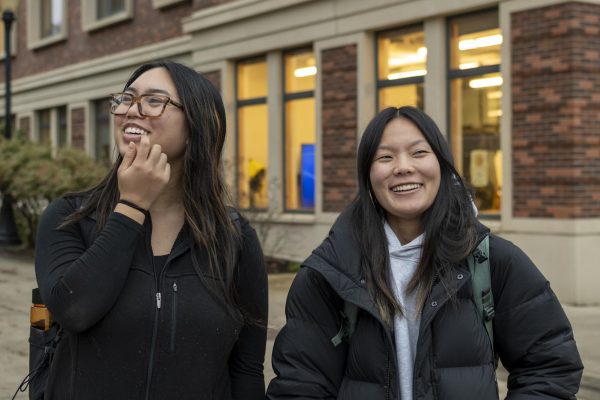
Callie Umeda, third-year public policy major
Callie Umeda, a third-year public policy major, shared about how her favorite trees were also the sequoias in the MU quad.
Umeda recalled how one time the trees were lit up in decoration, and how cool that was to her.
Jezreel Gaad, second-year BioHealth sciences major.
Jezreel Gaad, a second-year BioHealth sciences major, talked about how the Whitcomb Flowering Higan Cherry trees that line the MU were her favorite trees on campus. She shared how the pink blossoms make the trees special to her.
“They honestly make my day. Like when it’s springtime, and I’m walking underneath the trees, I’m like, ‘Oh my gosh, that’s so pretty.’”

began school at OSU.
Joshua Javier, third-year chemical engineering major.
Joshua Javier, a third-year chemical engineering major, said that they did not have a particular tree they enjoyed, but noted that the oak trees were one species on campus that they admired.
“I really like how many trees there are, especially since back home, I’m surrounded by a lot of trees. So one of my main worries coming to Oregon was whether there was going to be a lot of trees since I heard a lot of U.S. cities don’t have a lot of green. So I was happy to see how much trees there were on campus in general,” Javier said about the campus tree population.

David Barton, first-year electrical engineering major
David Barton, a first-year electrical engineering major, talked about how his favorite trees were also the sequoias in the MU quad.
“They do a great job on the campus around here, so it’s pretty cool.”

Graham Smith, Corvallis local
Graham Smith, a Corvallis local, said his favorite tree on campus was the American Elm by the Valley Library.
When thinking of choosing his favorite tree, Smith said, “It’s tough because you go to, like, the forestry department and all of that, that whole side of campus, and there’s a lot of special places too with trees that are memorable.”

Leo Kim, third-year fisheries and wildlife conservation science major
Leo Kim, a third-year fisheries and wildlife conservation science major, said that his favorite tree on campus was the moon tree down by Peavy Forest Science Center.
“I just, I didn’t realize that that was even a thing until probably, like two years ago. It’s just a cool story,” Kim said.

Ricky Aznak, first-year biology major
Ricky Aznak, a first-year biology major, said that his favorite tree was the Blue Atlas Cedar outside of Gilmore Hall.
Aznak noted how he enjoyed staring at the trunk of the tree because of how large it was.
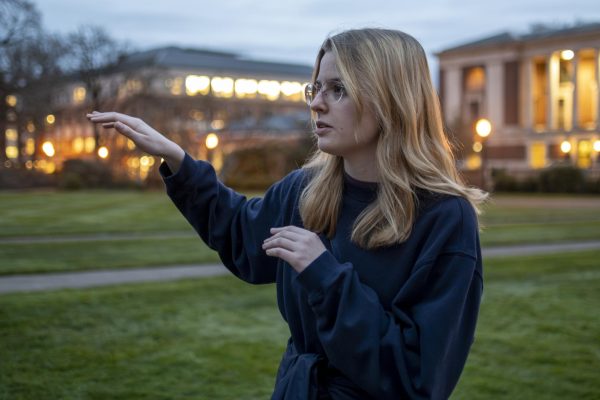
Noe Valley, third-year marketing major
Noe Valley, a third-year marketing major, said her favorite tree is a Red Maple by the black gate on the corner of SW 11th Street and SW Madison Avenue.
Valley said she really wants to try climbing the tree. When describing it, she said, “It’s got a lot of large, low-riding branches, and it looks very pretty in the fall.”

Max Libmann, third-year biochemistry major
Max Libmann, a third-year biochemistry major, said that his favorite tree was the Yoshino Cherry outside of the North side of Bexell Hall.
Libmann said how he really enjoyed how the tree turned pink in the spring.
“It’s a fairly asymmetrical tree, I think that’s kind of cool,” he said about the tree’s shape.
To see an interactive map showing where these people’s favorite trees are, see the link below.